Summary
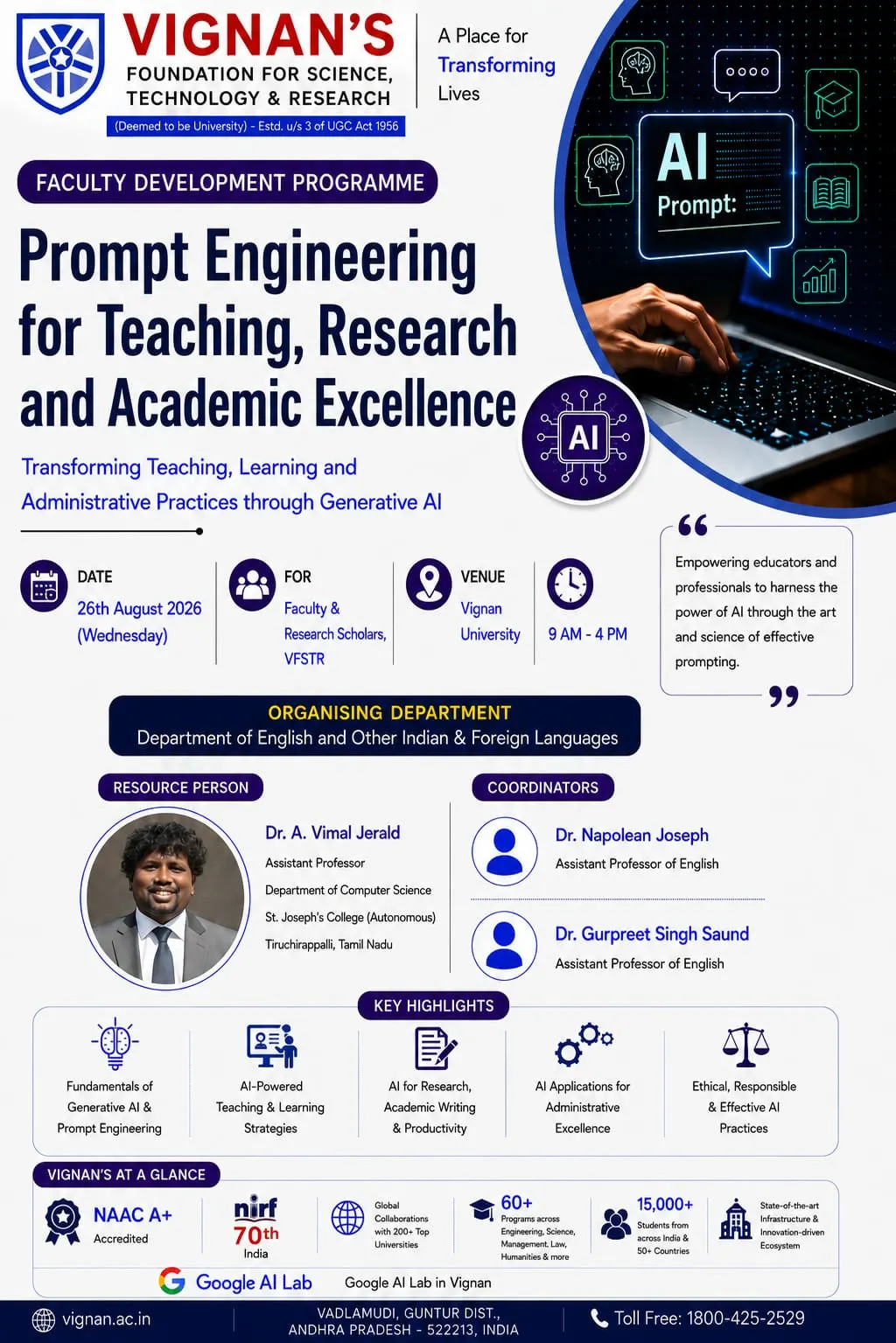
The Department of English and Other Indian & Foreign Languages, Vignan University, organised a Faculty Development Programme (FDP) titled Prompt Engineering for Teaching, Research and Academic Excellence on 26 August 2026. The programme was organised to familiarise faculty members and research scholars with the emerging applications of Generative Artificial Intelligence (AI) in higher education and integration of prompt engineering with particular emphasis on teaching, learning, research, academic writing, and professional practice. The FDP aimed to promote AI literacy and encourage the effective, critical, and responsible integration of AI into contemporary academic contexts.
About Event
The programme featured Dr. A. Vimal Jerald, Assistant Professor, Department of Computer Science, St. Josephs College (Autonomous), Tiruchirappalli, Tamil Nadu, as the Resource Person. The FDP comprised four sessions, combining conceptual discussions, demonstrations, examples, and hands-on activities. The sessions were designed to provide participants with a progressive understanding of Artificial Intelligence and prompt engineering, moving from foundational concepts and ethical considerations to practical application.
The first session focused on Artificial Intelligence, its role in teaching, and academic developments in the AI era. The session examined the growing significance of AI in higher education and discussed its influence on teaching, learning, academic communication, and research practices. Participants were introduced to the potential of AI-enabled tools to support the development of teaching resources, classroom activities, learning materials, and academic content. The discussion also highlighted the importance of retaining human judgement and pedagogical expertise while incorporating AI into educational practices.
An important component of the first session was the discussion of the ethical implications of AI. Participants reflected on issues concerning academic integrity, originality, authorship, reliability, bias, intellectual responsibility, and the need for human oversight. The session emphasised that effective engagement with AI requires not only technological familiarity but also critical awareness of its limitations and responsible use within academic environments.
The second session introduced participants to the fundamentals of Prompt Engineering. The session explored the principles of developing clear, specific, contextualised, and purposeful prompts for Generative AI systems. Participants learned how the formulation and structure of a prompt can influence the relevance and quality of AI-generated responses. Prompt engineering was presented as an important emerging skill that can enable educators and researchers to interact more effectively with AI tools and employ them for a range of academic purposes.
The third session focused on types of prompts and their applications. Participants were introduced to different approaches to prompting and examined how prompts can be adapted according to specific objectives and contexts. Examples demonstrated the application of prompts to teaching, learning, research, academic writing, content development, brainstorming, and productivity. The session highlighted the importance of precision, context, and clarity in obtaining meaningful outputs from Generative AI.
The fourth session provided participants with a hands-on experience in generating a simulation. Building upon the concepts introduced in the earlier sessions, participants applied prompt engineering techniques in a practical setting. The activity enabled them to develop, test, and refine prompts while observing how changes in instructions could influence the resulting AI-generated output. This experiential component helped bridge the gap between theoretical understanding and practical application and demonstrated the potential of Generative AI to support interactive and innovative academic practices.
The four sessions collectively established a progression from understanding AI and its ethical dimensions to developing practical competence in prompt engineering. The programme highlighted the potential of Generative AI to enhance teaching, learning, research, academic writing, and productivity, while also emphasising the importance of critical evaluation and responsible use. Participants were encouraged to approach AI as a supportive academic tool that can complement, rather than replace, human expertise, creativity, critical thinking, and scholarly judgement.
Overall, the FDP provided a valuable platform for faculty members and research scholars to engage with the possibilities and challenges presented by Generative AI. Through conceptual discussions, ethical reflection, demonstrations, and hands-on practice, the programme equipped participants with foundational knowledge of AI and prompt engineering and encouraged them to explore their applications in academic contexts. The programme ultimately reinforced the need for effective, ethical, and responsible engagement with AI as higher education continues to evolve in the AI era.