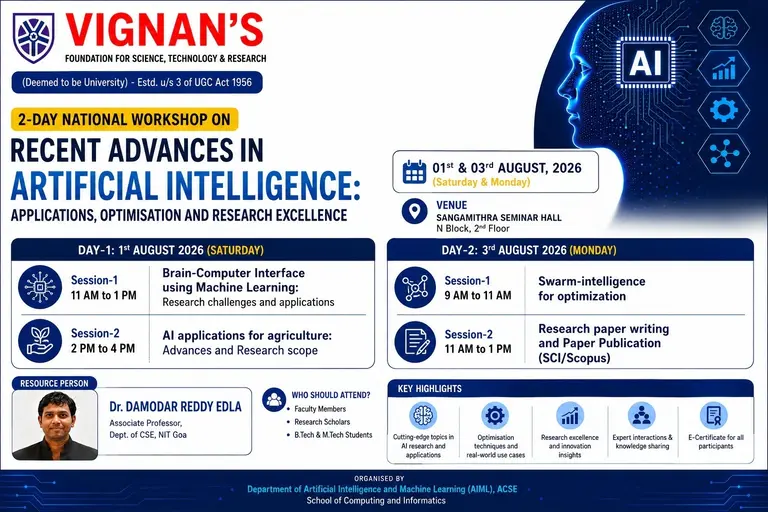
Summary
"Recent Advances in Artificial Intelligence: Applications, Optimization, and Research Excellence." Artificial Intelligence (AI) has become one of the most transformative technologies of the 21st century, revolutionizing the way we work, learn, communicate, and solve complex problems. Recent advancements in AI, particularly in generative AI, machine learning, deep learning, and large language models, have significantly improved the ability of computers to understand, reason, and generate human-like content.
AI is now widely applied in healthcare for disease diagnosis and drug discovery, in education through personalized learning systems, in agriculture for precision farming and crop monitoring, in finance for fraud detection and risk assessment, and in manufacturing through predictive maintenance and intelligent automation. It also plays a crucial role in transportation, smart cities, cybersecurity, environmental monitoring, and scientific research, demonstrating its potential to improve efficiency and decision-making across diverse sectors.
A key factor behind these achievements is the optimization of AI models. Researchers use advanced optimization techniques such as gradient-based learning, hyperparameter tuning, neural architecture search, model compression, pruning, and knowledge distillation to improve the accuracy, speed, and efficiency of AI systems while reducing computational costs and energy consumption. These techniques make AI more accessible for deployment on mobile devices, edge computing platforms, and real-time applications.
Research excellence in AI focuses on developing systems that are trustworthy, explainable, ethical, secure, and sustainable. Current research explores areas such as explainable AI, federated learning, multimodal AI, robotics, quantum AI, and AI for scientific discovery. These efforts aim to create intelligent systems that not only deliver high performance but also ensure fairness, transparency, privacy, and responsible use.
In conclusion, recent advances in Artificial Intelligence are transforming every aspect of modern society. By combining innovative applications with efficient optimization techniques and high-quality research, AI continues to drive technological progress and address global challenges. As students, researchers, and professionals, it is our responsibility to develop and use AI responsibly, ensuring that its benefits contribute to sustainable development and the betterment of humanity
About Workshop
1. Recent Advances in AI
Generative AI and LLMs: Models capable of generating high-quality text, images, code, audio, and video are improving productivity across many domains.
Multimodal AI: Modern AI systems can understand and combine text, images, speech, and video for more natural human-computer interaction.
AI Agents: Autonomous AI systems can perform complex tasks such as planning, reasoning, software development, and scientific experimentation.
Edge AI: AI models are increasingly deployed on smartphones, IoT devices, and embedded systems, reducing latency and protecting privacy.
Responsible AI: Research focuses on fairness, transparency, explainability, privacy preservation, and reducing bias in AI systems.
2. Applications of Artificial Intelligence
AI is widely applied across multiple sectors:
Healthcare: Disease diagnosis, medical imaging, drug discovery, personalized medicine, and robotic surgery.
Education: Intelligent tutoring systems, automated assessment, and personalized learning.
Agriculture: Precision farming, crop disease detection, and yield prediction.
Finance: Fraud detection, algorithmic trading, credit scoring, and risk management.
Manufacturing: Predictive maintenance, quality inspection, and industrial automation.
Transportation: Autonomous vehicles, traffic prediction, and logistics optimization.
Climate and Energy: Renewable energy forecasting, climate modeling, emissions monitoring, and smart grids.
Cybersecurity: Threat detection, anomaly detection, and automated incident response.
3. AI Optimization Techniques
Optimization improves AI performance, efficiency, and scalability.
Key techniques include:
Gradient-based optimization (SGD, Adam, RMSProp)
Hyperparameter optimization
Neural architecture search (NAS)
Reinforcement learning optimization
Metaheuristic algorithms (Genetic Algorithms, Particle Swarm Optimization)
Model compression, pruning, and quantization
Knowledge distillation
Energy-efficient and low-power AI for edge devices
Recent research also integrates AI with mathematical optimization to automate model formulation, parameter generation, and algorithm selection.
4. Research Excellence in AI
Current AI research emphasizes:
Explainable and trustworthy AI
Human-centered AI systems
AI for scientific discovery
AI for sustainability and climate solutions
Federated learning and privacy-preserving AI
AI-powered robotics and autonomous systems
Quantum AI and high-performance computing integration
Efficient AI models with lower computational and energy requirements