Summary
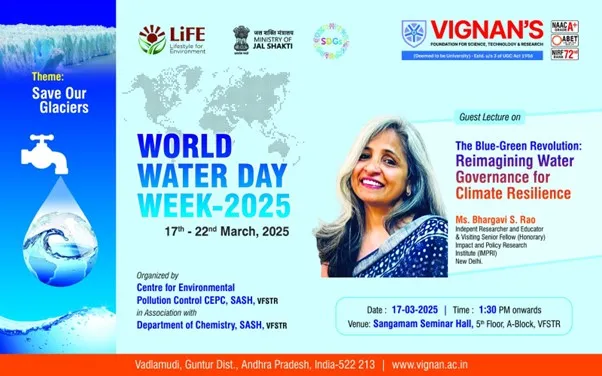
On March 22nd, 2025, the world will observe World Water Day, focusing on the theme "Glacier Preservation," designated by the United Nations.Centre for Environmental Pollution Control (CEPC), in association with the Department of Chemistry under the School of Applied Sciences & Humanities (SASH) has planned to organize a week-long celebration (March 17th – 22nd) featuring guest lectures, awareness programs, and student competitions.
About Others
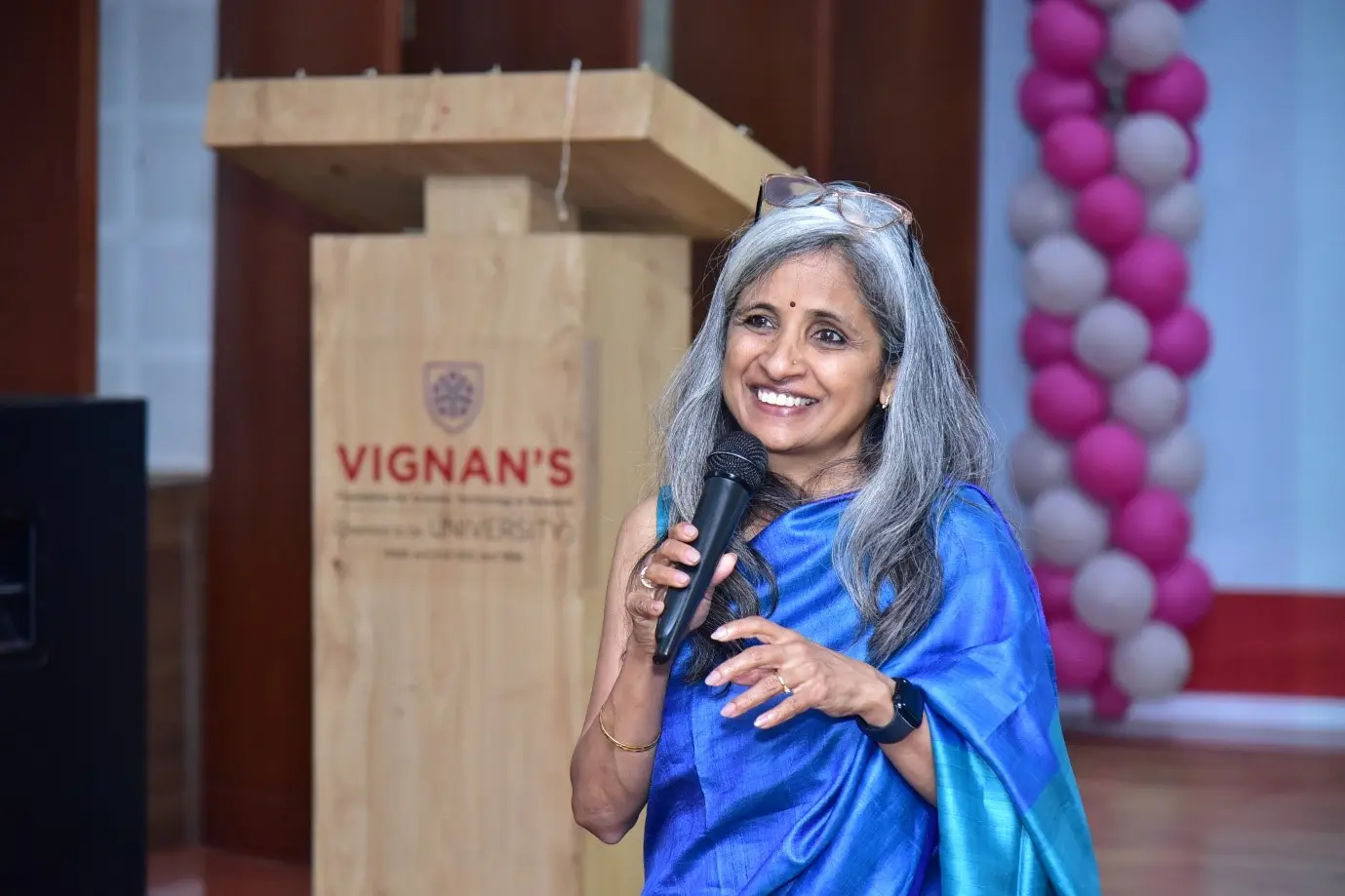
As part of the celebration, a guest lecture on “The Blue-Green Revolution: Reimagining Water Governance for Climate Resilience” was held on March 17th, 2025. The event commenced with the ceremonial lighting of the lamp, followed by welcoming o the guest and the other dignitaries on the dais by Dr. Tejaswini, followed by the introductory remarks from distinguished dignitaries, including Prof. N. Srinivasu (Dean, SASH) and Prof. K. Prabhakara Rao (HoD, Chemistry). All of them underscored the importance of water conservation, the expectation from the society and the sustainable practices implemented at VFSTR. The profile of the guest speaker, Ms. Bhargavi S. Rao, Activist, Environmentalist & Visiting Faculty at Impact and Policy Research Institute (IMPRI), New Delhi, was then introduced by Assoc. Professor Dr. M. V. K. Sri Vani before she took the stage.
Ms. Rao delivered an insightful talk on the urgent need for sustainable water governance in India. She highlighted the country’s rich history of indigenous water management, emphasizing the crucial role historically played by communities in maintaining lakes, tanks, and stepwells. However, she pointed out that rapid urbanization, pollution, and centralized control have led to the degradation of these critical water bodies. In her talk, she referenced the Sustainable Development Goals (SDGs) and the key legal frameworks such as the Water (Prevention and Control of Pollution) Act, 1974, stressing the importance of decentralized, community-driven water governance.
Discussing the ecological and socio-economic significance of lakes and wetlands, Ms. Rao illustrated their role in groundwater recharge, biodiversity conservation, and livelihood support. She also critiqued the privatization of lake management, arguing that community-led initiatives have proven more sustainable. Sharing her own experience related to successful conservation models, she urged for a shift towards participatory water management, where local stakeholders, particularly youth, actively contribute to safeguarding water resources. Concluding her talk, she called for a holistic approach to water conservation, integrating environmental restoration with social justice and economic resilience.
The lecture was well-received by undergraduate and postgraduate students across disciplines, as well as faculty members, who actively participated in the discussion. The event concluded with the felicitation of Ms. Rao, followed by a vote of thanks delivered by Dr. Ritam Bhattacharya. He expressed gratitude to the VFSTR management, including Chairman and Chancellor Dr. L. Rathaiah, Vice Chairman Mr. L. Krishnadevarayalu, Vice Chancellor Prof. P. Nagabhushan, CEO of VFSTR, Dr. K. Meghana, M. S. and the Registrar Cmde. Dr. M. S. Raghunathan, Prof. N. Srinivasu and Prof. K. Prabhakar Rao for their unwavering support. He also acknowledged the contributions from support-staff, the faculty members of CEPC and the Department of Chemistry and most importantly, the enthusiastic students who contributed to making the program a success.
With this impactful session, the CEPC’s World Water Day celebrations set the tone for continued discussions and actions toward sustainable water governance, reinforcing the collective responsibility to protect and conserve India’s water resources.