




Title Page
విజ్ఞాన శాస్త్ర సాంకేతిక పరిశోధనా సంస్థ / विज्ञान शास्त्र प्रौद्योगिकी और परिशोधन संगठन
Events
Others
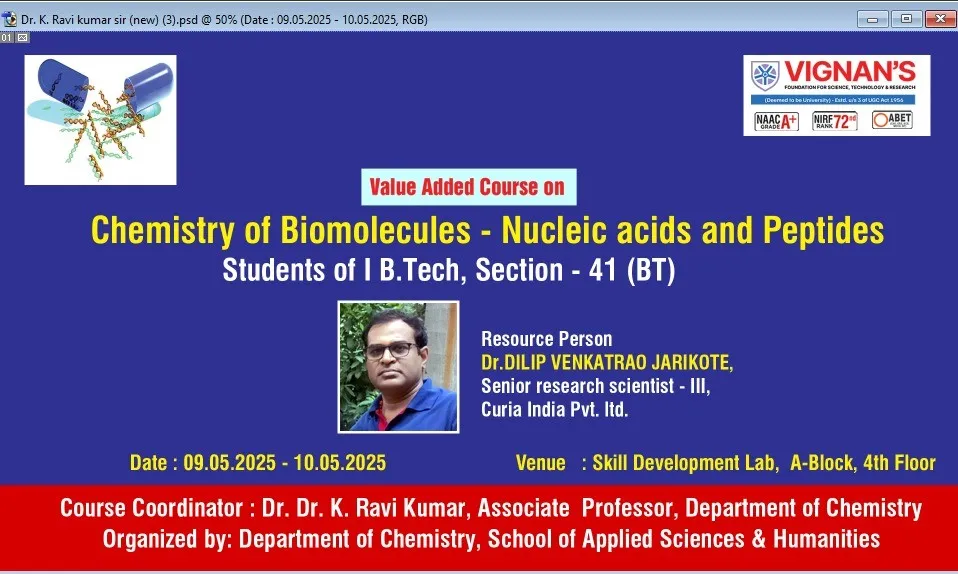
Value-Added Course on Chemistry of Biomolecules –Nucleic Acids and Peptides
May
9
Friday
09:00
AM
- 04:00
PM
Summary
The value-added course on Chemistry of Biomolecules – Nucleic Acids and Peptide Chemistry conducted for Section 41 of the first-year Biotechnology students provided a comprehensive insight into the molecular foundations of life, enriching the academic curriculum with advanced understanding and practical knowledge. The course began with a detailed exploration of the structural and functional aspects of biomolecules, with a particular emphasis on nucleic acids. Students gained clarity on the chemical composition, structural hierarchy, and biological significance of DNA and RNA, including their respective roles in genetic information storage and transfer. Through engaging lectures and interactive sessions, the mechanisms of DNA replication, transcription, and RNA processing were elucidated, highlighting the intricacies of enzyme involvement, regulatory factors, and fidelity mechanisms in nucleic acid synthesis. The course also delved into peptide chemistry, covering the structure and formation of peptides, peptide bond characteristics, and the principles of protein synthesis. Concepts such as amino acid classification, peptide chain conformation, and methods of peptide synthesis were thoroughly examined, bridging theoretical concepts with real-world biotechnological applications. By incorporating illustrative examples, problem-solving exercises, and discussions on modern techniques in molecular biology, the course helped students build a strong conceptual framework in biomolecular chemistry. The program not only enhanced the students’ understanding of critical biochemical processes but also laid a solid foundation for more advanced studies and research in the field of biotechnology. Overall, this value-added course significantly contributed to the holistic development of the participants by integrating chemical principles with biological functions, thereby fostering analytical thinking, scientific curiosity, and academic excellence among the students.
Read More
About Others
Objective of the Course: The primary objective of this value-added course was to enrich students’ understanding of biomolecular chemistry beyond the standard curriculum. It aimed to provide foundational knowledge and advanced insights into the structure, function, and synthesis of vital biomolecules including nucleic acids and peptides, which are central to molecular biology and biotechnology. Course Content Overview: 1. Introduction to Biomolecules: o Definition, classification, and importance of biomolecules. o Overview of biochemical building blocks – carbohydrates, proteins, nucleic acids, and lipids. o Emphasis on the role of biomolecules in biological systems and cellular processes. 2. Nucleic Acids – DNA and RNA: o Structure and chemical composition of DNA and RNA. o Types of RNA – mRNA, tRNA, rRNA – and their biological roles. o Base pairing, hydrogen bonding, and helical structures (Watson-Crick model). o Differences between DNA and RNA at structural and functional levels. 3. DNA and RNA Synthesis (Replication and Transcription): o Mechanism of DNA replication – key enzymes, origin of replication, and leading/lagging strand synthesis. o Concepts of semi-conservative replication, fidelity, and proofreading. o Transcription process – initiation, elongation, and termination. o Role of RNA polymerase and transcription factors. o Post-transcriptional modifications: splicing, capping, and polyadenylation. 4. Peptide Chemistry: o Introduction to amino acids – structure, classification, and properties. o Peptide bond formation and its significance. o Primary, secondary, tertiary, and quaternary structures of proteins. o Synthesis of peptides – chemical vs biological methods. o Applications of peptide synthesis in biotechnology and medicine. 5. Structure-Function Relationship in Biomolecules: o How structure determines biological function in DNA, RNA, and proteins. o Case studies showing mutation impacts, enzyme function, and protein folding. 6. Emerging Applications and Research Trends: o CRISPR and gene editing technologies. o Synthetic biology and designer peptides. o Nucleic acid-based diagnostics and therapeutics (e.g., mRNA vaccines). Teaching Methodology followed during the course: • Interactive lectures using multimedia presentations. • Conceptual discussions and real-world applications. • Diagrams and molecular models for better visualization. Student Outcomes: By the end of the course, students were able to: • Explain the structural features and functions of DNA, RNA, and proteins. • Describe the biochemical processes of DNA replication and RNA transcription. • Understand the fundamentals of peptide chemistry and protein structure. • Appreciate the relevance of these molecules in genetic engineering and biotechnology. • Apply this knowledge to solve basic problems in molecular biology and bioengineering.

Read More
Venue
Skill Development Lab, A-Block, 4th Floor & VBF-04, A-Block, First Floor
Dept.of Chemistry
About Speakers
Speaker 1 name
Speaker Designation
Speaker 2 name
Speaker 2 Designation
Event Coordinator
Coord1 Name
Coord1 Designation
Contact Us
Vignan's Foundation for Science, Technology and Research
(Deemed to be University), Vadlamudi, Guntur-522213
info@vignan.ac.in
0863-2344700 / 701
Be The First to Know.
Copyrights © 2026 Vignan University. All rights reserved.