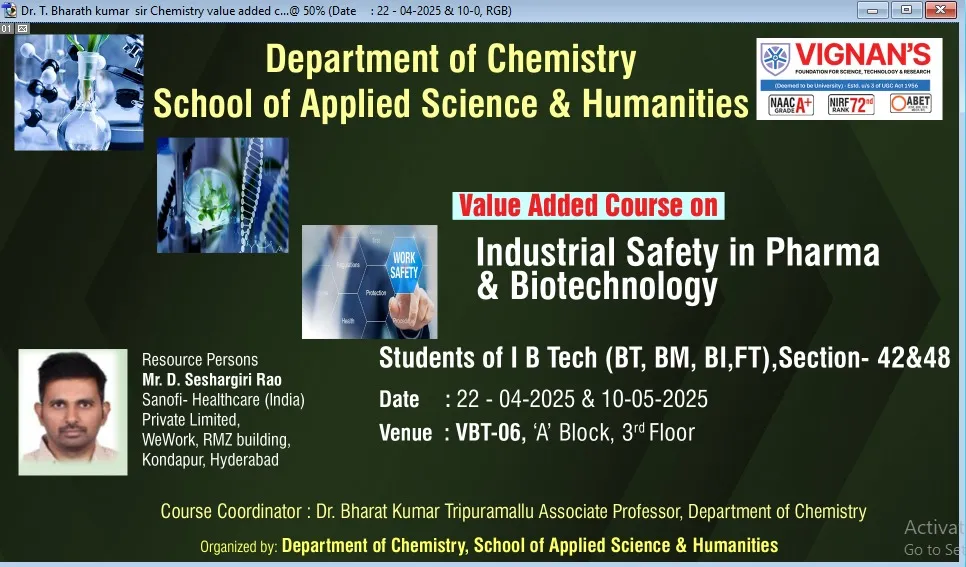
The course was meticulously structured to achieve three key learning outcomes:
1. Understanding Regulatory Compliance and Standards
2. Identifying and Mitigating Workplace Hazards
3. Fostering a Safety-First Culture and Emergency Preparedness
The course was offered to students of biotechnology, bioinformatics, biomedical and food technology, It combined theoretical instruction with real-life case studies, interactive discussions, and multimedia presentations to provide a holistic learning experience.
________________________________________
Course Objective
The primary goal of this course was to bridge the knowledge gap between academic learning and industrial requirements regarding safety. By focusing on real-world applications and industry best practices, the course sought to:
• Develop a foundational understanding of industrial safety protocols specific to the pharma and biotech industries.
• Familiarize students with international and national safety standards (such as OSHA, GMP, GxP, ICH Guidelines, etc.).
• Highlight the importance of proactive hazard identification, assessment, and control mechanisms.
• Equip participants with strategies for handling emergencies and ensuring preparedness at all levels of operation.
• Promote a mindset where safety is not just a compliance requirement but a core value of every organizational process.
________________________________________
Session Breakdown
1. Opening Remarks and Context Setting
The course commenced with a formal welcome by the internal course coordinator, who emphasized the growing relevance of industrial safety in academic curricula. The context was set by drawing parallels between chemical handling in academic labs and industrial-scale operations in pharma and biotech setups.
Mr. Seshagiri Rao was introduced by a senior faculty member, highlighting his contributions to safety innovation and compliance management at Sanofi Healthcare.
2. Workplace Hazards – Identification and Mitigation
This module explored practical strategies for identifying potential hazards in a manufacturing or research environment. The following concepts were addressed:
• Hazard Identification Tools: HAZOP (Hazard and Operability Study), Fault Tree Analysis, Risk Matrix.
• Types of Hazards:
o Chemical Hazards: Exposure to APIs (Active Pharmaceutical Ingredients), solvents, reagents.
o Biological Hazards: Contamination, exposure to genetically modified organisms (GMOs), biohazard waste handling.
o Physical Hazards: Noise, heat, radiation, and mechanical equipment.
o Ergonomic Hazards: Repetitive tasks, workstation design.
The session included detailed case studies of past industrial accidents and how they could have been prevented through proactive safety measures. Participants were engaged in group activities to analyze mock scenarios and propose mitigation strategies.
3. Fostering a Safety-First Culture
This critical module centered on building a culture of safety from top to bottom. Mr. Rao emphasized that safety must be ingrained in the organizational DNA rather than treated as a checklist.
• Leadership and Accountability: Role of management in promoting safety.
• Training and Continuous Education: Regular workshops, refresher training, and e-learning modules.
• Behavior-Based Safety (BBS): Observing and reinforcing safe behavior at the workplace.
• Communication and Reporting Systems: Near-miss reporting, suggestion systems, feedback loops.
Case studies from Sanofi were shared to demonstrate successful cultural transformations driven by employee engagement and leadership commitment.
4. Emergency Preparedness and Response Mechanisms
Emergencies in pharma-biotech sectors range from chemical spills to fire hazards, biocontainment breaches, and environmental releases. This module delved into:
• Emergency Response Plans (ERP): Components, implementation, and rehearsal.
• First Aid and Medical Response: Equipping staff with basic first aid knowledge and medical kits.
• Evacuation Protocols: Planning, drills, and signage.
• Coordination with Local Authorities: Fire departments, pollution control boards, health departments.
Key Takeaways
The following insights emerged as central themes throughout the course:
• Prevention is better than cure – The cost of prevention is a fraction of the cost of incident management.
• Documentation is critical – If it’s not documented, it’s not done.
• Training never ends – Safety training should be iterative, evolving with new threats and technologies.
• Everyone is responsible for safety – From senior management to janitorial staff, everyone plays a role in ensuring a safe working environment.
Conclusion
The value-added course on Industrial Safety in Pharma and Biotechnology marked a significant educational milestone for the Department of Chemistry. The partnership with Sanofi and the insights of Mr. Seshagiri Rao created a transformative experience for participants, blending theory with real-world practicality.
As industries demand ever-higher standards of safety and compliance, initiatives like this course play a vital role in shaping the next generation of responsible scientists and industry professionals.