

Title Page
విజ్ఞాన శాస్త్ర సాంకేతిక పరిశోధనా సంస్థ / विज्ञान शास्त्र प्रौद्योगिकी और परिशोधन संगठन
Events
Guest Lecture
Modern Analytical Techniques
Apr
23
Wednesday
02:00
PM
- 04:00
PM
Summary
The guest talk on Modern Analytical Techniques was an enriching session that covered key concepts and real-world applications of advanced instrumentation in chemical analysis. The speaker began by emphasizing the importance of water analysis, highlighting the routine testing of parameters like pH, turbidity, total dissolved solids, conductivity, ionic content (chloride, nitrate, fluoride), and heavy metals such as lead and arsenic, which are critical in pharmaceutical, food, and environmental industries. He then stressed the significance of proper laboratory behavior, including the use of personal protective equipment, maintaining cleanliness, accurate labeling, adherence to standard operating procedures, and responsible waste disposal, all of which form the foundation of a safe and efficient lab environment. Moving into instrumentation, he explained the principle and application of Karl Fischer titration for precise moisture content analysis using iodine and sulfur dioxide in alcohol, widely used in petrochemical and pharmaceutical industries. UV-Vis Spectrophotometry was introduced as a quick and reliable method for determining the concentration of compounds based on their light absorbance, commonly applied in drug and biochemical analysis. The speaker then detailed Gas Chromatography (GC), used for separating and analyzing volatile substances, critical in petroleum refining, flavor testing, and forensic science. High-Performance Liquid Chromatography (HPLC) was described as an indispensable tool in pharmaceutical quality control, offering accurate separation and quantification of drug compounds under high pressure using various detectors like UV or PDA. He also elaborated on Atomic Absorption Spectroscopy (AAS), which is used to detect and quantify metal ions such as lead and zinc by measuring the light absorbed by atoms, playing a vital role in environmental monitoring and food safety. Lastly, the session covered Inductively Coupled Plasma (ICP) techniques, including ICP-OES and ICP-MS, which enable ultra-trace detection of multiple elements simultaneously, essential for advanced material analysis, environmental testing, and regulatory compliance. In addition to technical insights, the speaker highlighted a wide range of career opportunities for chemistry graduates and postgraduates in industries such as pharmaceutical companies, petrochemical refineries, environmental testing labs, food and beverage quality control, forensic science labs, clinical research organizations (CROs), paint and polymer industries, water treatment plants, and government regulatory bodies like BIS, FSSAI, and Pollution Control Boards.
Read More
About Guest Lecture
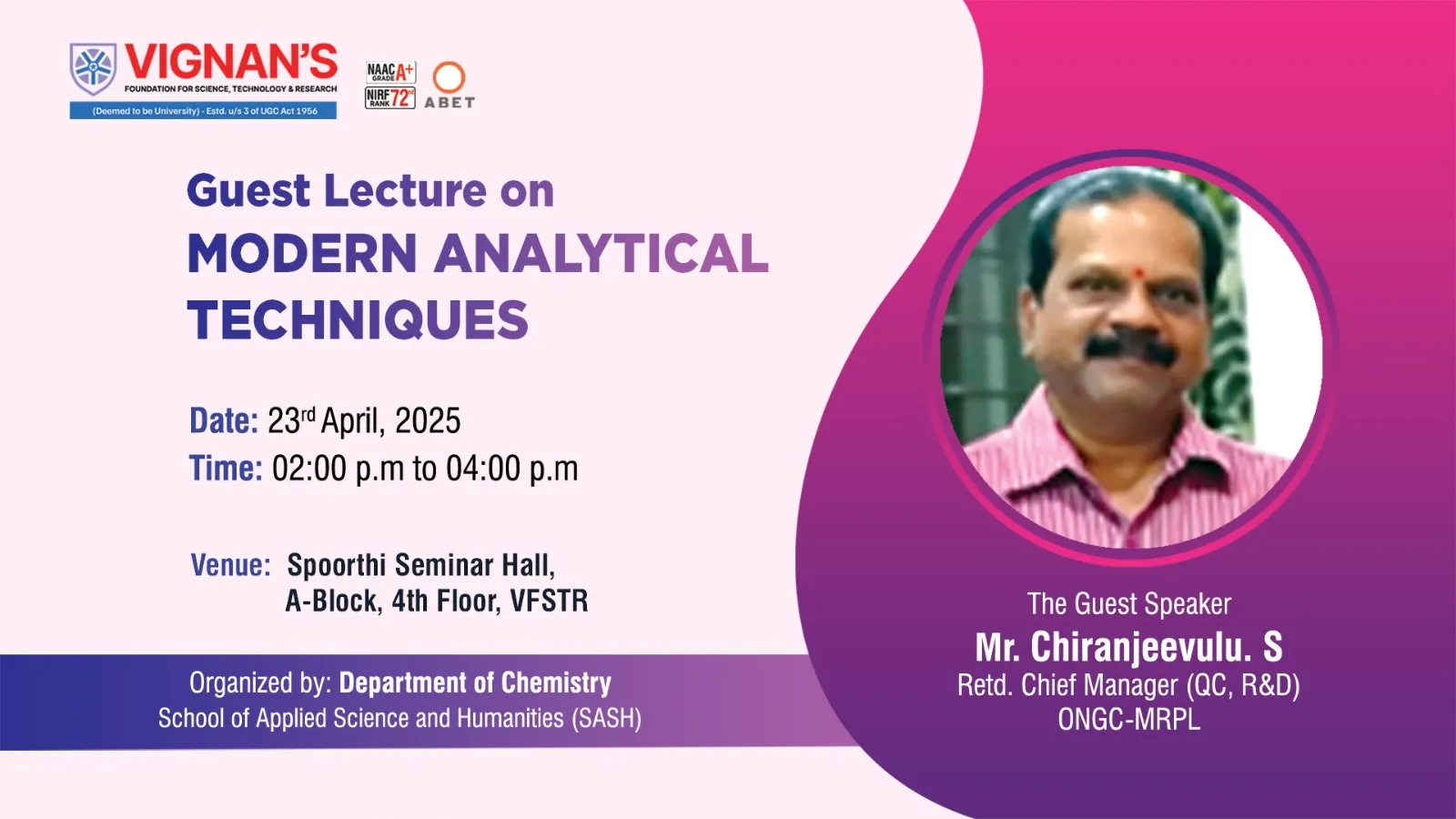
The Department of Chemistry organized a guest talk on Modern Analytical Techniques on 23/04/2025, aimed at enriching students' understanding of advanced instrumental methods in chemical analysis. The session commenced at 2:00 PM and was formally inaugurated with a welcome address by Dr. Chandrasekar Kuppan, officiating professor in the Department of Chemistry. The guest speaker for the session was Mr. Chiranjeevulu S., Retired Chief Manager (QC, R&D), ONGC-MRPL, who brought with him over 24 years of extensive experience in quality control and research and development at various managerial levels. Mr. Chiranjeevulu delivered an insightful talk, drawing from his industrial expertise to explain key modern analytical techniques including Karl Fischer Titration, UV-Vis Spectrophotometry, Gas Chromatography (GC), High-Performance Liquid Chromatography (HPLC), Atomic Absorption Spectroscopy (AAS), and Inductively Coupled Plasma (ICP). He also highlighted the real-time industrial applications of these instruments, the importance of water and environmental analysis, and career opportunities for students in QC, R&D, and regulatory fields. The session was attended by first- and second-year M.Sc. Chemistry students, research scholars, and faculty members from both the Chemistry and Biotechnology departments, creating a vibrant interdisciplinary learning environment. The lecture concluded at 4:00 PM, followed by a tea break. An engaging interactive session was held afterward, during which students and faculty members posed insightful questions, making the event both informative and stimulating.

Read More
Venue
Spoorthi Seminar Hall, 4 th floor, A block
Dept.of Chemistry
Contact Us
Vignan's Foundation for Science, Technology and Research
(Deemed to be University), Vadlamudi, Guntur-522213
info@vignan.ac.in
0863-2344700 / 701
Be The First to Know.
Copyrights © 2026 Vignan University. All rights reserved.