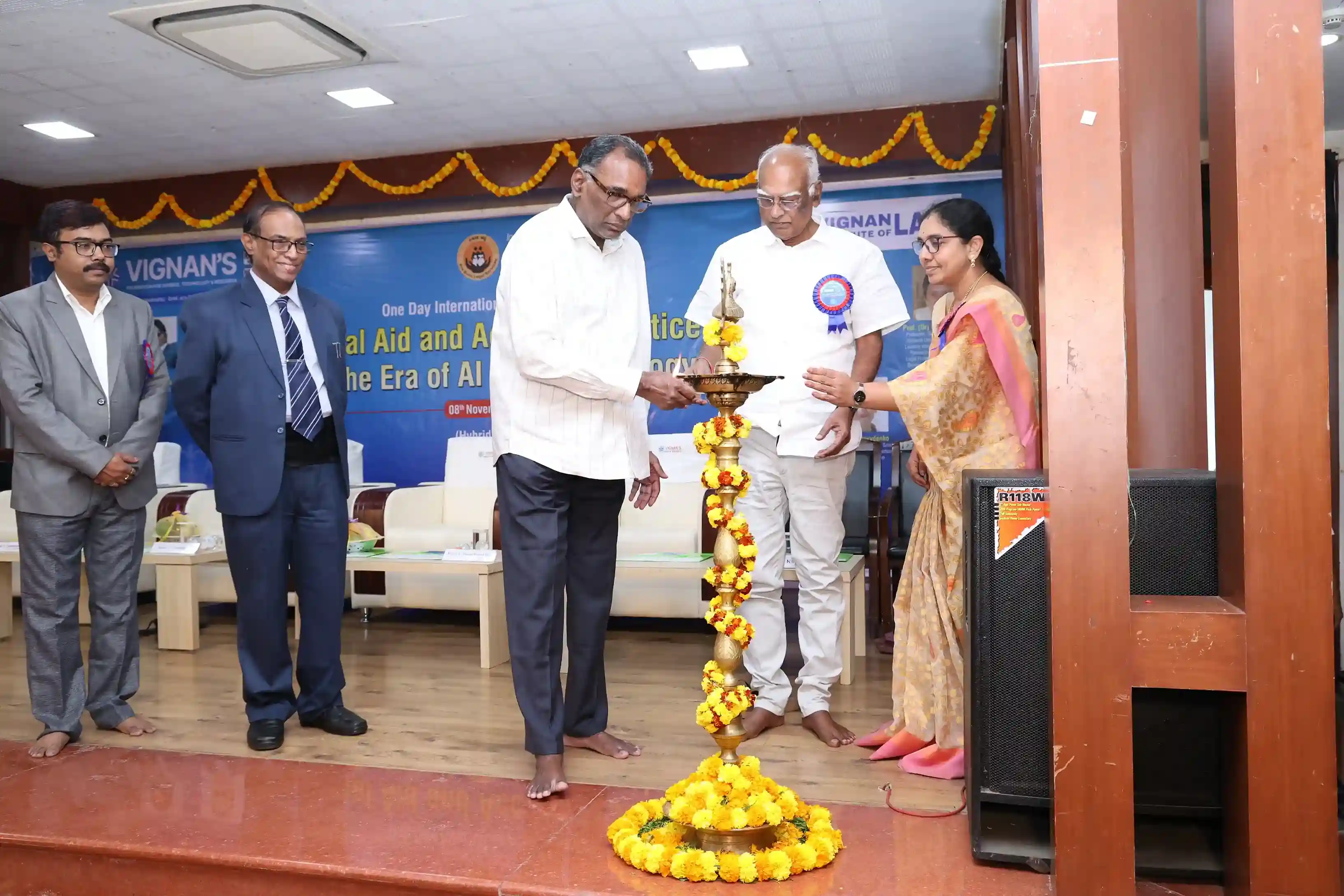
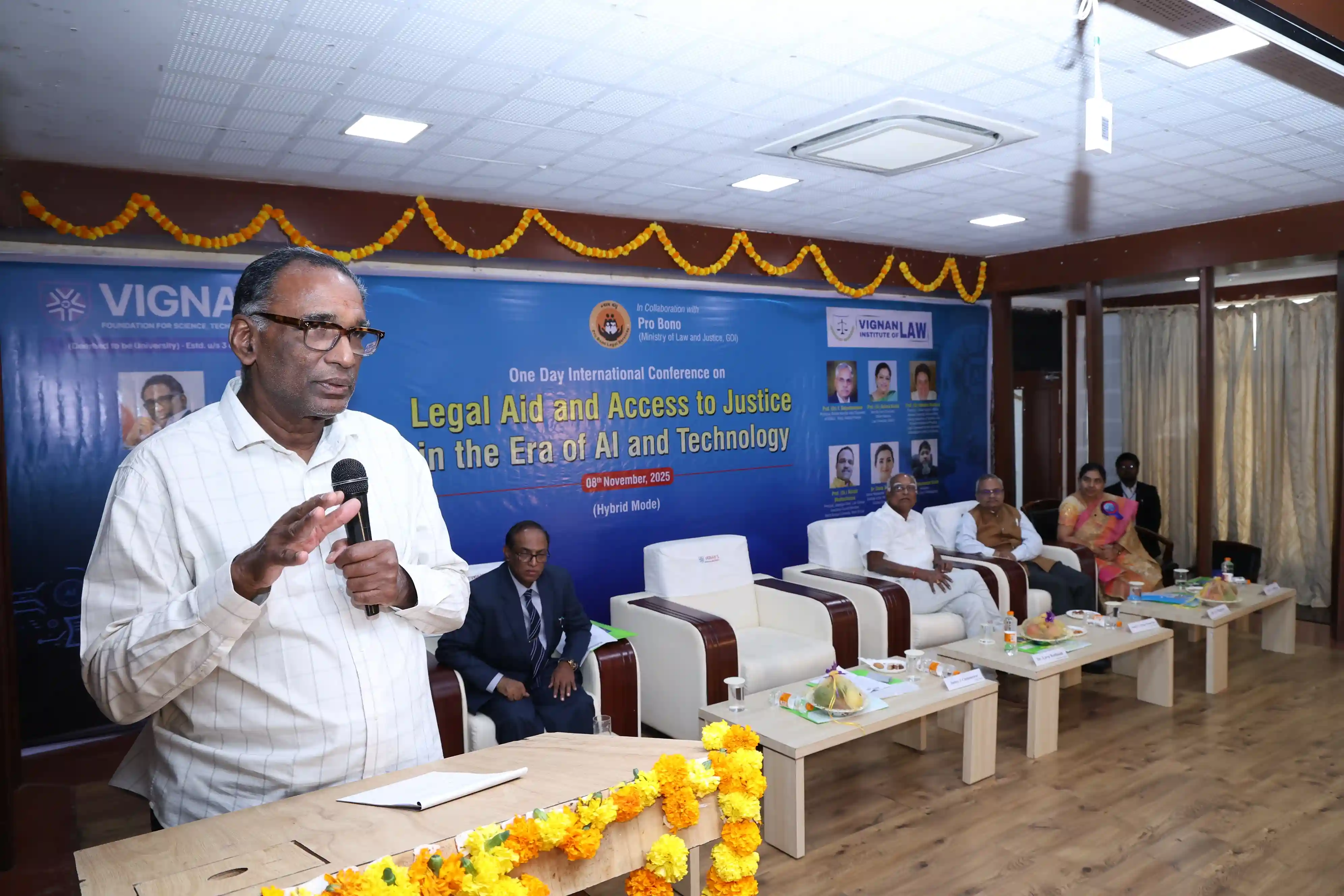
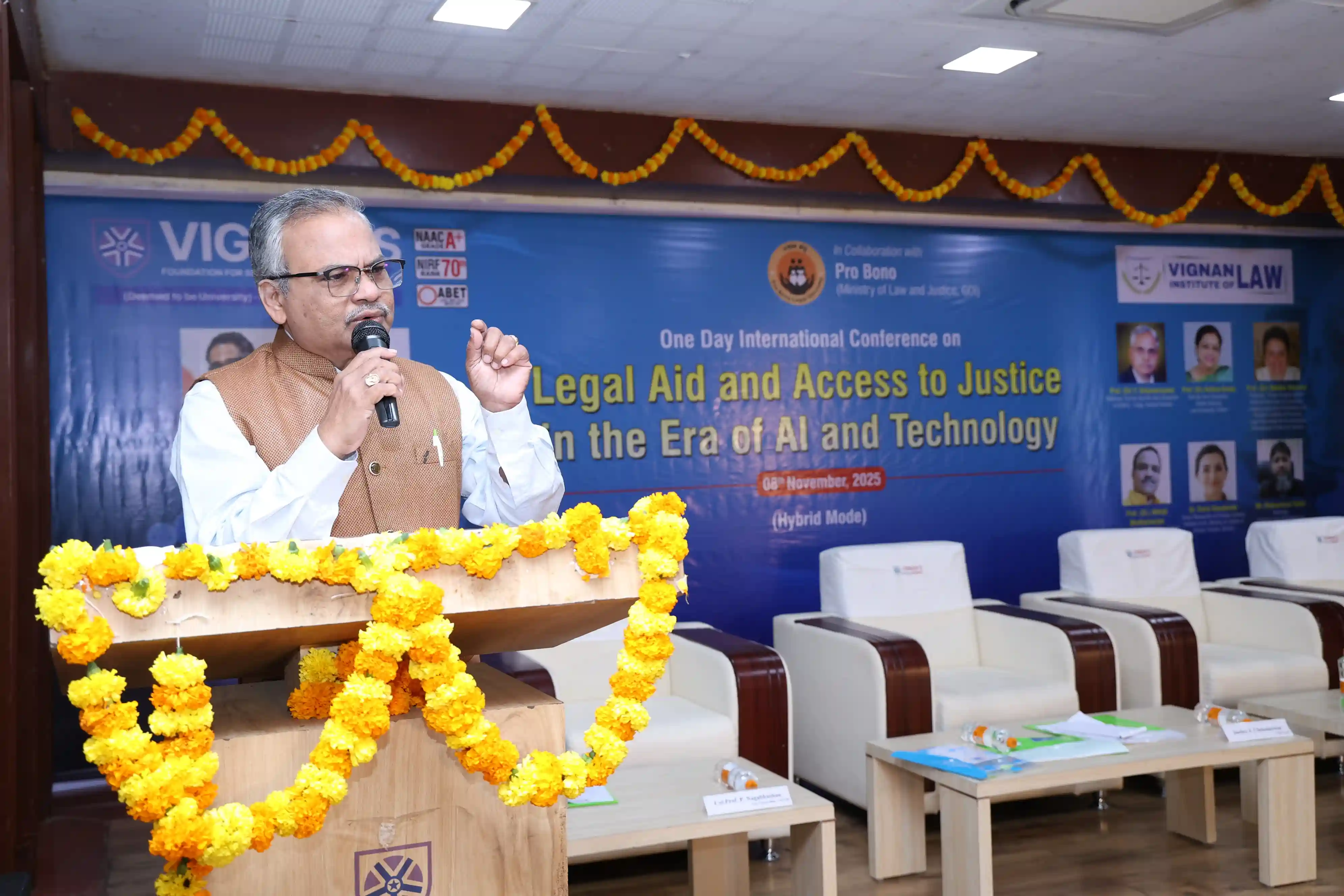
The conference opened with a formal inauguration that set the tone for a day of reflective yet forward-looking deliberations. The programme was graced by distinguished judicial dignitaries Justice Jasti Chelameswar (Former Judge, Supreme Court of India) and Justice U. Durga Prasad Rao (Former Judge, High Court of Andhra Pradesh) alongside institutional leadership including Dr. Lavu Rathaiah and Chairman, Vignan Group of Institutions and Prof. P. Nagabushan, Vice-Chancellor, VFSTR along with Prof. K. Kalpana, Dean School of Law & Management, VFSTR and Dr. Partha Sarothi Rakshit, Director, Vignan Institute of Law, VFSTR. The conference started with the opening remarks by Dr. Partha Sarothi Rakshit, Director, Vignan Institute of Law followed by speeches of the Chairman and Vice-Chancellor of VFSTR who emphasized the need for higher-education institutions to lead conversations on technology and law by combining technical literacy with a commitment to social justice. In their remarks they have stated that AI can never replace the Legal Profession and Judges as there is an element of human sensitization is involved with the litigants and witnesses etc. The keynote interventions by the former judges framed the legal and ethical stakes: participants were reminded that while AI and technology present opportunities to widen legal aid coverage, they also raise risks algorithmic bias, exclusion of digitally illiterate communities, threats to privacy, and a potential erosion of procedural safeguards if human oversight is neglected. The speakers advocated a cautious, rights-based approach that places the dignity and agency of vulnerable litigants at the center of technological design and deployment. A notable feature of the conference was its hybrid design and the curatorial insistence on publishing selected papers. Delegates from across India and international contributors shared empirical studies, normative essays and case studies. The hybrid mode also enabled remote participants, advocates and legal-aid activists to participate in discussions, enriching practical perspectives. Key insights from discussions and deliberations included that:
• AI systems should augment, not replace, human lawyers and legal aid officers particularly where discretionary judgment and empathy are essential (family law, custody, criminal defense). Panels flagged the danger of delegating core adjudicative or advice-giving tasks to opaque systems.
• Participants of this conference highlighted the digital divide. Several presenters demonstrated that without language localization, low-bandwidth design and offline interfaces, technological tools risk entrenching existing inequities rather than removing them.
• Scholars called for mandatory transparency standards for any AI tool used in legal aid contexts (clear documentation of training data, performance benchmarks, and independent audit mechanisms). This was linked to a suggested role for law schools and research centers in conducting third-party audits.
• Conversations balanced short-term practical steps (training legal-aid lawyers in digital tools; pilot programs with NGOs and university clinics) with longer-term regulatory design (standards, certification and redress mechanisms for faulty or biased systems).
By focusing on practical pathways, capacity building and clear regulatory guardrails participants sought to reframe technology as a tool that can expand access to justice if deployed deliberately and ethically.
The keynote addresses were followed by the technical sessions wherein the presenters shared their perspectives related to how AI can be best utilized in the Indian legal landscape. The conference successfully blended high-level judicial and policy perspectives with grounded practitioner and academic work. A total of 76 Research papers were submitted to this International Conference and it witnessed a participation of more than 250 participants. Selected, peer-reviewed contributions would be collected and published as a volume with an ISBN a step intended to widen the impact of the conference and preserve its recommendations for policymakers and civil society.
The involvement of eminent jurists and institutional leadership gave the event both gravitas and a realistic sense of the challenges ahead; the hybrid format and the plan to publish an edited volume ensure the conversation can continue beyond the single day. This International conference functioned as a call to action: to couple technical experimentation with a rights-based, inclusionary framework that protects the most vulnerable users of the justice system.