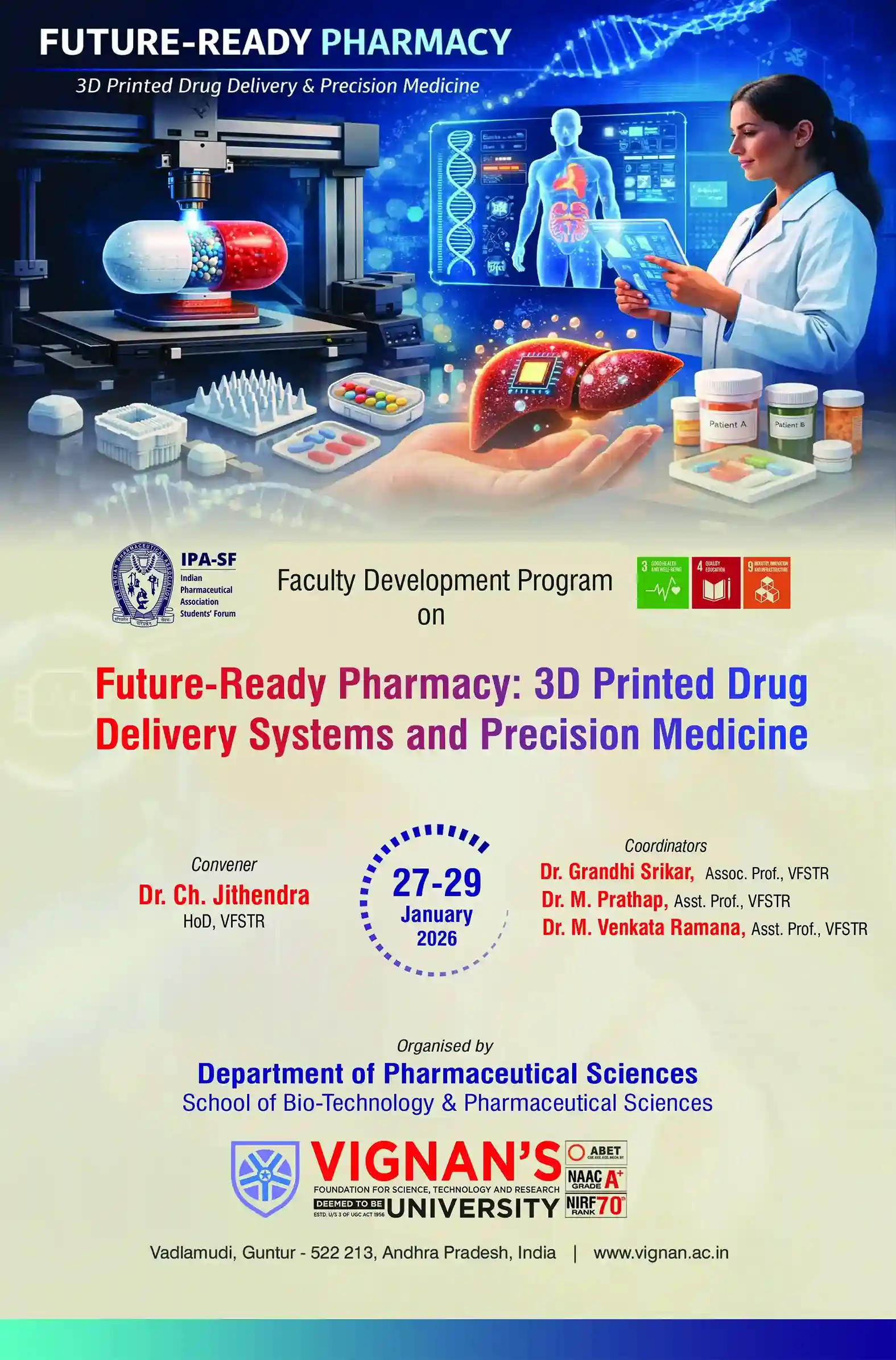
The Department of Pharmaceutical Sciences, SBPS, VFSTR, organized a three-day Faculty Development Programme titled Future-Ready Pharmacy: 3D Printed Drug Delivery Systems and Precision Medicine from 27th to 29th January 2026. The programme commenced with a formal inaugural session marked by the traditional lighting of the lamp and welcome of dignitaries. Prof. D. Vijaya Ramu emphasized the growing importance of integrating emerging technologies such as 3D printing and precision medicine into pharmacy education and research. Dr. Ch. Jithendra highlighted the department’s initiatives in advanced drug delivery and pharmaceutical innovation. The objectives of the FDP included skill enhancement, technological awareness, and interdisciplinary collaboration. Participants were oriented towards the transformative potential of additive manufacturing in drug development. The inaugural session set an academic and research-driven tone for the subsequent scientific deliberations.
On Day 1, the first scientific session on 3D Printing Applications in Pharmaceutical Sciences was delivered by Prof. Prakash Katakam. He explained the evolution of additive manufacturing and discussed technologies such as FDM, SLA, SLS, and inkjet printing. The session elaborated on applications including personalized tablets, implants, polypills, and controlled-release systems. Challenges related to regulatory requirements, reproducibility, and scale-up were also addressed. The second session was conducted by Dr. Sriram Nagaraju, focusing on hands-on training in personalized medicine through 3D printing. He demonstrated the workflow of digital modeling, formulation design, and fabrication of customized dosage forms. Participants gained practical insight into translating theoretical concepts into real-world pharmaceutical applications.
Day 2 featured a session by Dr. Falguni Pati, Head of Biomedical Engineering, IIT Hyderabad, who emphasized advanced biomedical applications of 3D printing. He introduced the concept of bioprinting, which integrates biomaterials, living cells, and growth factors to fabricate tissue-like constructs. The discussion covered patient-specific implants, scaffolds, and regenerative therapies enabled by additive manufacturing. He explained the use of printed tissue models for studying drug permeability, toxicity, and pharmacological responses in vitro. The role of 3D printing in developing prosthetics and implantable drug delivery devices was highlighted. Translational challenges, regulatory aspects, and future directions in regenerative medicine were also discussed. The session provided participants with a broader biomedical perspective of pharmaceutical 3D printing.
On Day 3, Dr. Firdoz Shaik delivered a lecture on Nanozymes in Modern Biomedical Applications: From Enzyme Mimicry to Smart Diagnostics and Therapeutics. He introduced nanozymes as nanomaterials exhibiting enzyme-like catalytic properties with enhanced stability and tunable activity. The mechanisms of enzyme mimicry and factors influencing catalytic performance were explained in detail. Diagnostic applications of nanozyme-based biosensors for detecting biomarkers and pathogens were highlighted. Therapeutic roles in antimicrobial activity, cancer therapy, and oxidative stress modulation were discussed. The integration of nanozymes with smart drug delivery and precision medicine approaches was emphasized. The FDP concluded with interactive discussions, enriching participants understanding of next-generation pharmaceutical technologies and research opportunities.