Summary
Day 1 – January 2, 2026
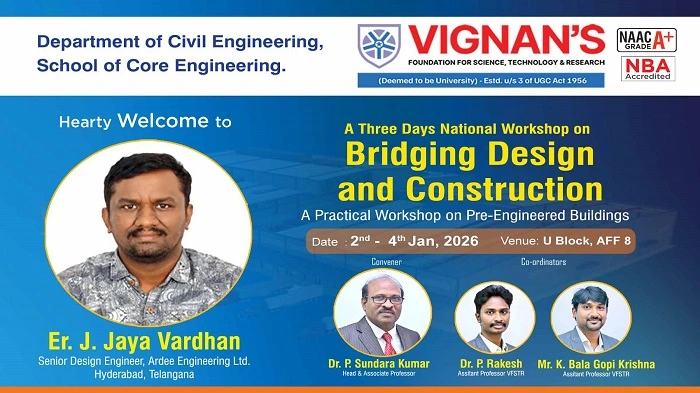
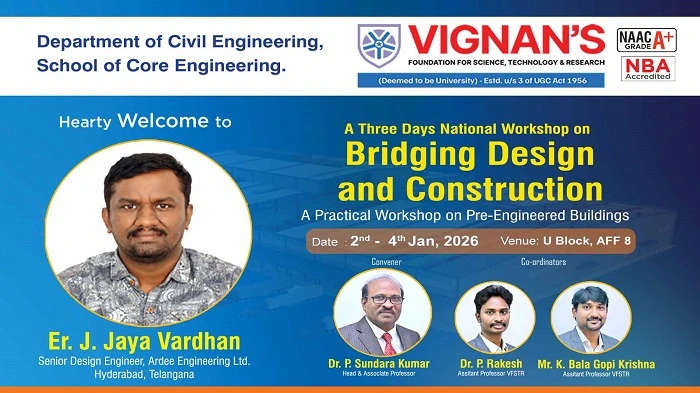
The Department of Civil Engineering, VFSTR, organized a Three Days National Workshop on “Bridging Design and Construction: A Practical Workshop on Pre-Engineered Buildings (PEB)†from 2nd to 4th January 2026, with the objective of bridging the gap between theoretical design concepts and real-time construction practices in the rapidly evolving field of Pre-Engineered Buildings.
The workshop commenced with an inaugural session in which the chief guest, Er. J. Jaya Vardhan, Senior Design Engineer, Ardee Engineering Ltd., Hyderabad, was formally welcomed by the coordinators of the workshop. The inaugural address included a brief introduction to the chief guest and the background of PEB construction, highlighting its evolution and significance as an emerging technology in the Civil Engineering domain, delivered by Dr. P. Rakesh, Assistant Professor and workshop coordinator. Subsequently, Mr. K. Bala Gopi Krishna, Assistant Professor, motivated and encouraged the participants by emphasizing the importance of PEB systems in modern infrastructure development and their growing relevance alongside advanced technologies.
Following the inaugural session, the technical proceedings of Day 1 were handed over to the resource person and were primarily focused on providing a comprehensive understanding of Pre-Engineered Buildings, covering the fundamental concepts, evolution, and industry relevance of PEB systems. The sessions included detailed discussions on various PEB components such as primary and secondary structural members, cladding systems, and connections, along with an in-depth explanation of the design philosophy of PEB structures with special emphasis on load considerations and relevant design codes. The day concluded with the presentation of real-time industrial case studies, wherein practical challenges encountered during the design and construction of PEB projects and their effective solutions were discussed, enabling participants to gain valuable industry-oriented insights and practical exposure.
Day 2 – January 3, 2026
The second day of the workshop was dedicated to the structural design and detailing aspects of Pre-Engineered Buildings, providing participants with in-depth technical knowledge and practical exposure. The sessions focused on the structural design of key PEB components such as columns, rafters, and various bracing systems, with detailed explanations of their behavior under different loading conditions. Significant emphasis was placed on connection design and detailing, including moment-resisting connections, shear connections, and base plate connections, highlighting their critical role in ensuring structural safety and performance.
The resource person also explained the complete PEB design workflow, starting from conceptual planning and preliminary design to detailed analysis and preparation of fabrication drawings. In addition, the participants were introduced to commonly used software tools and modeling approaches adopted in the PEB industry, enabling them to understand how theoretical design concepts are translated into accurate digital models and practical fabrication-ready outputs.
Day 3 – January 4, 2026
The final day of the workshop emphasized the execution and performance aspects of Pre-Engineered Buildings, providing participants with practical insights into on-site implementation and long-term structural behavior. The sessions covered various erection methodologies adopted in PEB projects, along with site safety practices and tolerance control measures essential for achieving quality construction and minimizing execution errors.
The resource person also discussed cost optimization techniques, project planning strategies, and approaches to enhance material efficiency, highlighting the economic advantages of PEB systems over conventional construction methods. Further, the sessions addressed maintenance strategies, performance evaluation methods, and failure analysis of PEB structures, enabling participants to understand the importance of durability, serviceability, and preventive maintenance.
At the end of the workshop the coordinators have taken a feedback from a total of 70 B. Tech Civil Engineering students and the overall response from the participants was highly positive. The students expressed that the workshop significantly improved their understanding of industry-oriented design practices and helped them effectively relate classroom concepts to real-time construction scenarios.
They also highlighted that the sessions provided clear insights into career opportunities in the domains of Pre-Engineered Buildings and steel structures. The interactive sessions enabled students to clarify their doubts related to design decisions, execution challenges, and professional expectations in the construction industry, thereby making the workshop highly effective and impactful. In their reflections, students mentioned that the workshop helped them understand how structural design is actually carried out in industry using PEB systems, and that the inclusion of case studies and real project examples made the sessions practical and easy to comprehend. They also appreciated the detailed explanations on load calculations, bracing systems, and erection practices, stating that these aspects would be highly beneficial for their future academic and professional careers.