Title Page
విజ్ఞాన శాస్త్ర సాంకేతిక పరిశోధనా సంస్థ / विज्ञान शास्त्र प्रौद्योगिकी और परिशोधन संगठन
Events
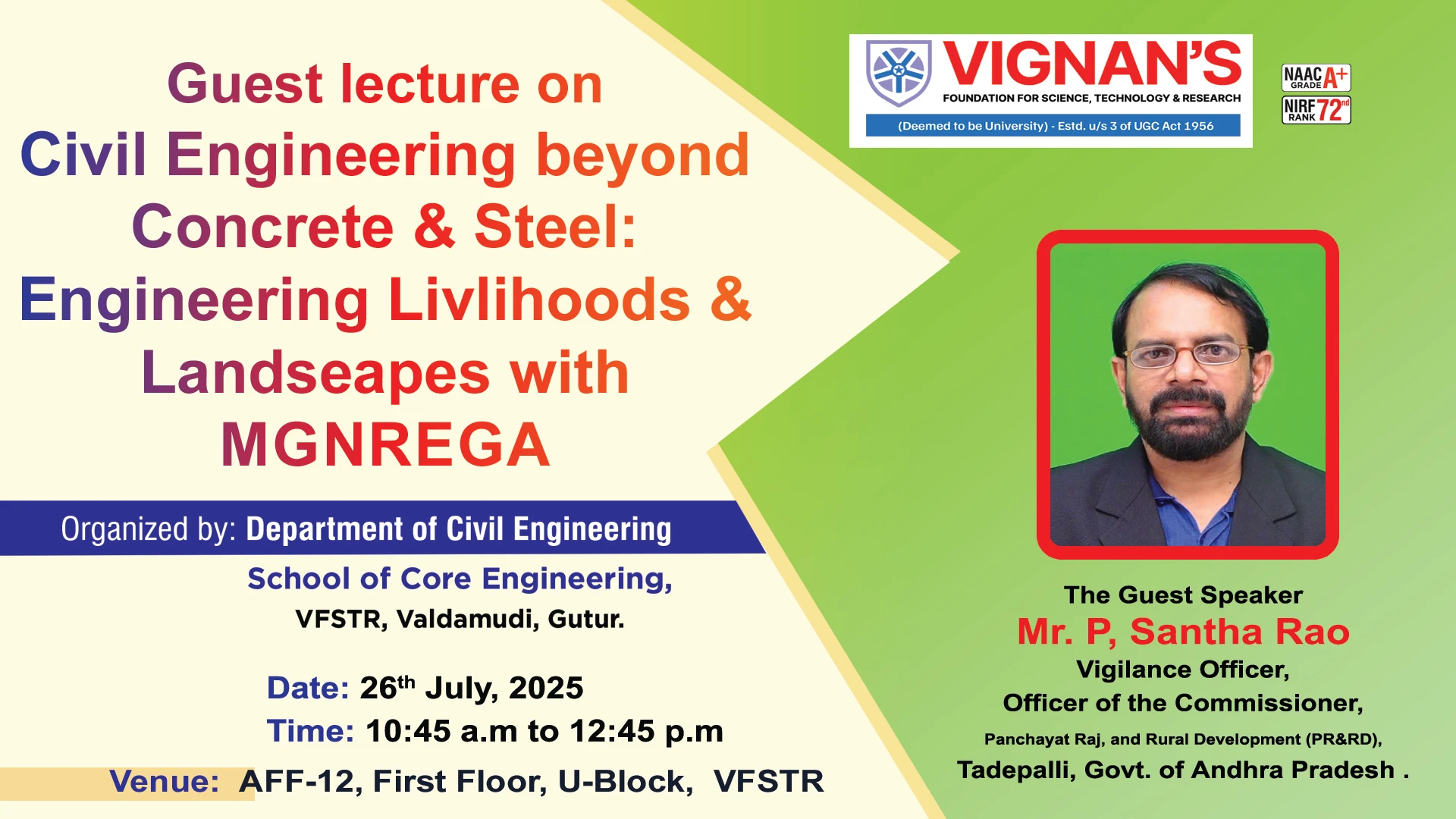
Guest Lecture
Civil Engineering Beyond Concrete & Steel: Engineering Livelihoods and Landscapes with MGNREGA
Jul
26
Saturday
10:45
AM
- 01:10
PM
Summary
Guest Lecture on Civil Engineering beyond concrete and steel - Engineering livelihoods and landscapes with MGNREGA Guest Speaker : P. Santha Rao, Vigilance Officer, Office of the Commissioner, Panchayat Raj & Rural Development (PR&RD), Tadepalli, Government of Andhra Pradesh Date and time : 26th July, 2025 (Saturday), 10:45 am - 12:45 pm Mode & Location: Offline & U-Block, AFF-006 Room Evolution of Engineering The engineering practice is as ancient as civilization, The formal profession of engineering was born in the 18th century when Civil Engineering started to focus on building things for the public—like roads and bridges, instead of only for the military. This foundational engineering discipline soon gave rise to Mechanical Engineering, catalyzed by the Industrial Revolution's demand for new machinery and power-driven systems. From the beginning, engineering kept growing into different branches, with each new discovery or invention creating a new type of engineering. Civil Engineering The Foundation of Infrastructure When early humans began to abandon their nomadic lifestyle and started settling in one place, the need for permanent shelter became essential. This major shift happened around 10,000 years ago during the Neolithic Age, when agriculture began to replace hunting and gathering. People started to grow their own food and domesticate animals, which made it possible to live in one area for a long time. Transportation  During the same time, transportation became increasingly important leading to the development of the way, wheel and sailing. Origins & Milestones  Civil engineering traces back to ancient civilizations of Egypt, Rome, and China, making it the oldest recognized engineering discipline.  Milestone inventions include the arch, dome, and Roman concrete - revolutionary structural elements that enabled buildings to span greater distances and bear heavier loads The Appian Way by Roman engineers (312 BCE) Pyramids of Egypt, 2700–2500 BCE (Designed as eternal resting places for Egyptian kings) “John Smeaton, England, 1724 to 1792, Father of civil engineering, is the first person to call himself a “civil engineer” to distinguish his work from military engineering He built Eddystone light house in 18th century. He used. • Hydraulic lime (an early form of concrete that sets underwater). • Interlocking stone blocks, which improved strength and stability. Advancing towards infrastructure projects These advancements on construction technology, concrete technology, design as well as material front have given way for the construction of some historical infrastructure projects like • Bridges • highways, • sky scrapers, • ports and • airports etc Today, civil engineering continues to transform our world through o Design: Visualize and simulate performance before building o Construction Monitor progress, cost, and safety using real- time data o Operations Track structural health, energy use, and wear- and-tear o Maintenance Predict and prevent failures using AI-based insights Internet of things Ground water depletion If you plan for need and safety You get safe roads to fulfil your needs

Read More
About Guest Lecture
GUEST LECTURE SUMMARY REPORT 1. Introduction The Department of Civil Engineering organized a guest lecture to expose students to emerging opportunities in the realm of rural infrastructure development and socio-technical engineering interventions under national flagship programmes. This lecture aimed to broaden students’ perspectives beyond conventional civil engineering practices and highlight the crucial role engineers can play in livelihood generation and sustainable landscape management. 2. Objectives of the Guest Lecture • To create awareness about MGNREGA and its impact on rural development • To emphasize the relevance of civil engineering skills and techniques in community-driven works • To sensitise students to sustainable, low-cost interventions beyond concrete and steel • To motivate budding engineers to explore career opportunities in government development projects 3. Details of the Event 3.1 Title of the Lecture Civil Engineering Beyond Concrete & Steel: Engineering Livelihoods and Landscapes with MGNREGA 3.2 Date & Time 26th July, 2025 (Saturday), 10:45 am – 12:45 pm 3.3 Venue & Mode ASF-006, U-Block (Offline mode) 3.4 Resource Person Profile P. Santha Rao, Vigilance Officer, Office of the Commissioner, Panchayat Raj & Rural Development (PR&RD), Government of Andhra Pradesh. He has extensive experience in monitoring and implementation of rural development projects under MGNREGA, with specialization in public systems management, transparency mechanisms and field-level engineering supervision in infrastructure works across the state. 4. Brief Overview of MGNREGA The Mahatma Gandhi National Rural Employment Guarantee Act (MGNREGA) is a government flagship programme aimed at enhancing livelihood security in rural areas by guaranteeing 100 days of wage employment through creation of durable assets. Civil engineering plays a crucial role in planning, designing and execution of works like water harvesting structures, micro-irrigation systems, rural roads, flood control measures, farm ponds, and soil conservation interventions. 5. Key Highlights of the Lecture • Conceptual Insights: • Transition from traditional infrastructure to livelihood-centric engineering • Role of civil engineers in sustainable development using local materials • Technical Inputs: • Design and execution of earth bunds, check dams, soak pits, farm ponds, percolation tanks, earthen roads • Planning techniques for watershed management • Quality control and transparency mechanisms in MGNREGA works • Case Studies / Examples: • Success stories from Andhra Pradesh villages • Rainwater harvesting projects executed under MGNREGA • Community participation in project selection and implementation 6. Student & Faculty Participation Over 70 B.Tech Civil Engineering students and 7 faculty members actively participated in the lecture. The event witnessed enthusiastic queries and engagement from the participants. 7. Learning Outcomes and Takeaways • Awareness about public development schemes requiring civil engineering expertise • Understanding of sustainable landscape-based construction practices • Inspiration to contribute towards nation-building through rural development programs • Insight into government procedures and project opportunities 8. Interactive Session (Q&A) Students posed questions related to field challenges in rural development and sustainable engineering, project cost optimization, internship opportunities in PR&RD departments, and the scalability of MGNREGA projects. The speaker addressed the questions with real-time examples from site experience. 9. Feedback & Responses Feedback collected from participants reflected high satisfaction with the relevance of the topic, practical exposure, and motivation received. Around 94% of students rated the lecture as “Highly Useful”. Fig. Shared Feedback form through WhatsApp Network 11. Photographs of the Event Photographs capturing the inaugural address, lecture delivery, participant interaction, and felicitation ceremony are enclosed in the annexure section. 12. Conclusion The guest lecture successfully enriched students with new perspectives on the role of civil engineers in development beyond urban infrastructure. The Department aims to continue such engagements to support holistic learning and industry-government linkage for the benefit of future engineers.

Read More
Venue
ASF - 006 U Block
Dept.of Civil Engineering
About Speakers
Mr. P. Santha Rao
Vigilance Officer, Office of the Commissioner, Panchayat Raj & Rural Development (PR&RD), Tadepalli, Government of Andhra Pradesh
Event Coordinator
Dr. J.G.Rao
Assistant Professor
Contact Us
Vignan's Foundation for Science, Technology and Research
(Deemed to be University), Vadlamudi, Guntur-522213
info@vignan.ac.in
0863-2344700 / 701
Be The First to Know.
Copyrights © 2026 Vignan University. All rights reserved.